

Masaru Knives Malaysia
Touroku Sakai - Shirogami #2 Kasumi 300mm Yanagiba
Touroku Sakai - Shirogami #2 Kasumi 300mm Yanagiba
Couldn't load pickup availability
Share
Touroku Sakai – A Connection to Japanese Knife Craftsmanship
Touroku Sakai represents a connection to Japan's rich knife-making heritage, bringing together the skills and craftsmanship of different specialists within Japan's knife industry.
Rather than focusing on a single workshop or individual blacksmith, their approach involves working with skilled craftsmen from established knife-making regions, each contributing their own expertise and techniques.
From forging and blade construction to sharpening and finishing, Japanese knife production is built upon generations of specialised knowledge. Touroku Sakai brings these different elements together, offering a collection that reflects the diversity and depth of Japanese knife craftsmanship.
What makes Japanese knives fascinating is that every region, workshop and craftsman has their own philosophy, techniques and interpretation of what makes a great blade. Touroku Sakai gives us another opportunity to appreciate this diversity.
Who is Masaya Shimizu
清水将矢
Masaya Shimizu is a Japanese knife sharpener based in Sakai, Osaka, with a strong focus on traditional Japanese knife sharpening and blade finishing. His particular strength lies in single-bevel knives, especially in restoring damaged blades and correcting their geometry. We first came across his work through YouTube, where he regularly showcases the restoration of heavily damaged knives. We have been following his work ever since.
What makes his work particularly impressive is his ability to maintain the straightness and consistency of a single-bevel blade, ensuring that the geometry remains true throughout the sharpening process. To him, sharpening is not simply about creating a sharp edge, but about understanding the blade, correcting its imperfections and bringing it back to its full potential.
Shirogami – White Paper Steel (White Steel)
White Steel, also known as Shirogami (白紙鋼), is one of Japan's most traditional carbon steels used in Japanese kitchen knives.
Interestingly, the name does not come from the colour of the steel itself, but from the white paper used to label and wrap the steel at Hitachi Metals in Japan.
There are three main grades of Shirogami: #1, #2 and #3. The main difference is their carbon content. #1 has the highest, followed by #2 and #3.
Generally, Shirogami #1 can achieve exceptional sharpness and edge retention, while #3 is softer and may be easier to maintain. #2 offers a good balance between the two. The actual performance also depends on heat treatment and blade geometry.
One of the reasons Shirogami is loved by chefs is how easily it responds to sharpening. With a whetstone and a little practice, it can be brought back to an exceptionally sharp edge in a short amount of time.
It is especially popular among sushi chefs who value precision and clean cuts.
As a reactive carbon steel, Shirogami can oxidise and rust relatively quickly when exposed to moisture. It requires proper care, including cleaning and drying after every use.
For those who appreciate traditional Japanese craftsmanship, Shirogami offers a rewarding experience through its sharpness, sharpening response and connection between the knife and the whetstone.
Spec:
- Made In : Sakai
- Brand: Touroku Sakai
- Sharpener : Masaya Shimizu 清水将矢
- Knife Type: Yanagiba
- Blade
- Grind: Single Bevel Blade ( Right-Handed )
- Hagane (Core Steel): Shirogami #2 ( White #2 )
- Jigane (Cladding): Carbon Steel
- Hardness: 61-62 HRC
- Blade Finishes:
- Kasumi Polished
- Blade Length: 300mm
- Blade Height (at heel): 34mm
- Spine Thickness
- Above heel: 4.5mm
- Tip: 4mm
- Handle
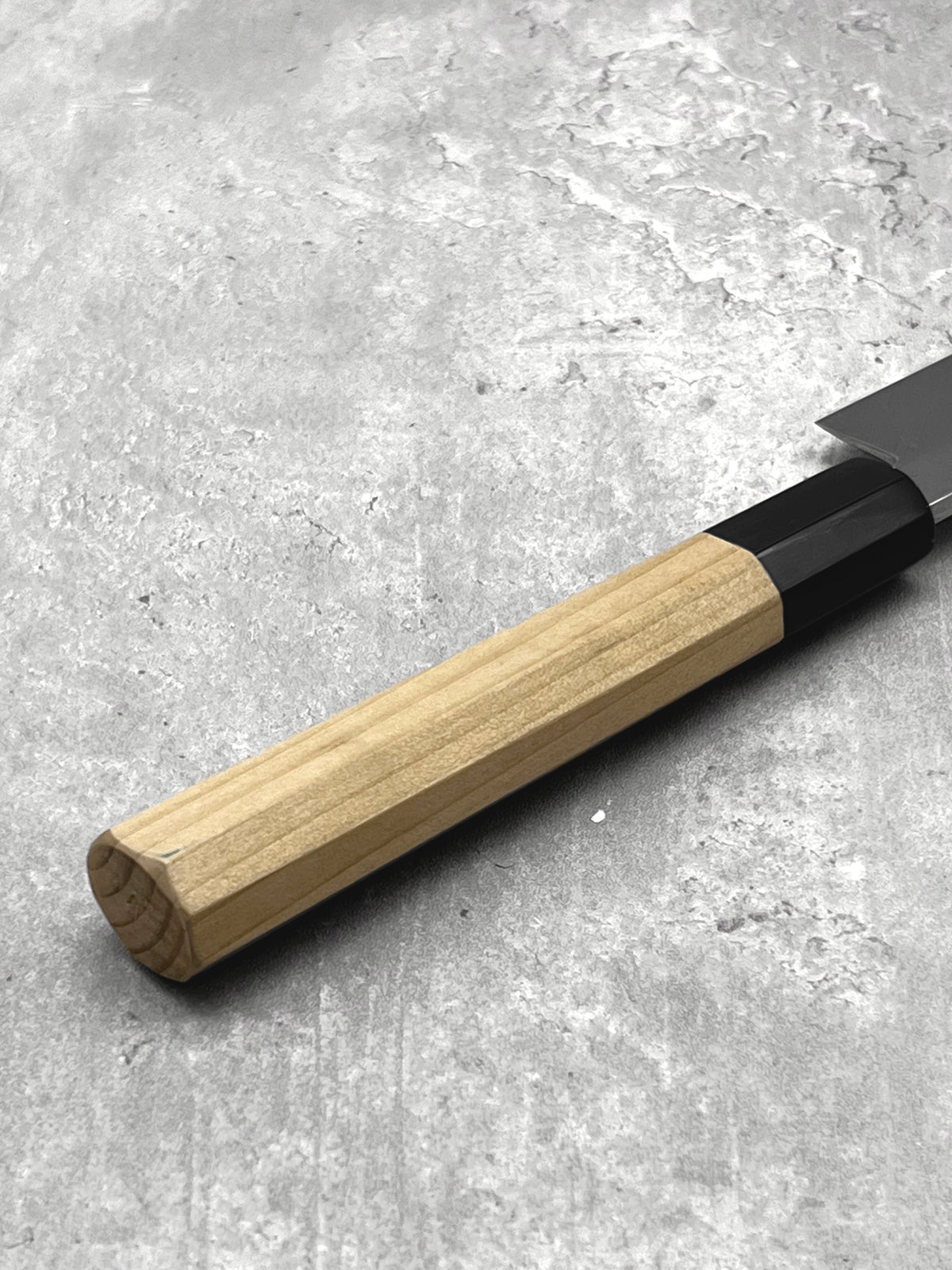
- Octagon Magnolia Water Buffalo Horn Collar
- Weight: 210g
- Engraved Mark: In Japanese Kanji "Touroku Sakai" (佐海登录) , "Masaya Shimizu's Signature"(将)
Please note :
This is a high carbon steel blade therefore it has the potential to rust if is not take care properly.
Please make sure the knife is kept dry after usage and during storage and apply a layer of oil every time after using it. The blade will change its colour due to oxidation and also after in contacting with acid. This is perfectly normal and we often called this is patina.
Please note that the edge may appear black due to the photography lighting, but it is not actually black.